
Blog: Beyond Silos—How Strategic Partnerships Transform Stuck Initiatives
ARTICLE HIGHLIGHTS
When technically sound initiatives remain practically stuck, the breakthrough isn't found in working harder—it's found in working together differently. This piece reveals how an external coach and internal leader transformed a Fortune 500 division plagued by conflict and zero visibility into a psychologically safe, high-performing team. Their partnership reduced customer escalations by 90% and enabled $100M in business growth—in just 10 months—through three partnership principles: Practice, Perspective, and Progress.
"Most organizational problems are not technical problems. They are human partnership problems."
This insight from Rashmi Fernandes and Kumaresh Ramaswamy opened a masterclass for alums and set the stage for a powerful exploration of partnership as a leadership practice—not just a nice-to-have, but an essential capability for navigating complexity.
When Good Strategies Meet Bad Dynamics
The session began with a deceptively simple question: "Write down one initiative in your organization that is technically sound but practically stuck."
Pete B. immediately identified one of Agile Leadership Journey’s own programs—solid content, proven results, but challenged by organizational budget constraints. The pattern was universal across participants: strategies failed not from poor design but from human dynamics that no amount of technical excellence could overcome.
Rashmi and Kumaresh then presented their case study—a scenario so familiar it drew audible recognition from participants.
The Context: A software R&D division at a Fortune 500 organization, 75+ team members, 1M+ lines of code, sales in 150+ countries.
The Challenge: Teams in constant high-conflict mode, working in silos, radio silent in meetings. Management had zero visibility into ground-level issues while customer escalations threatened revenue. Anxiety, burnout, and blame culture drove high turnover.
"If you were in a position of power, what would you do?" Rashmi asked.
Pete B.'s first response? "Run."
But three participants offered instincts that proved prophetic. Paul S. mentioned the five dysfunctions of a team and surfacing the inability to have conflict. Josh F. emphasized starting with interviews to understand different perspectives. Sally T. focused on visibility as the essential first step: "If you can't see it, how do you address it?"
"That's exactly what we did," Rashmi confirmed.
The DARE Approach: Creating Conditions for Change
Rashmi and Kumaresh developed what they call the DARE approach—Discovery, Alignment, Rhythm, Enablement. The approach wasn't planned from the start; they reverse-engineered it after the work succeeded.
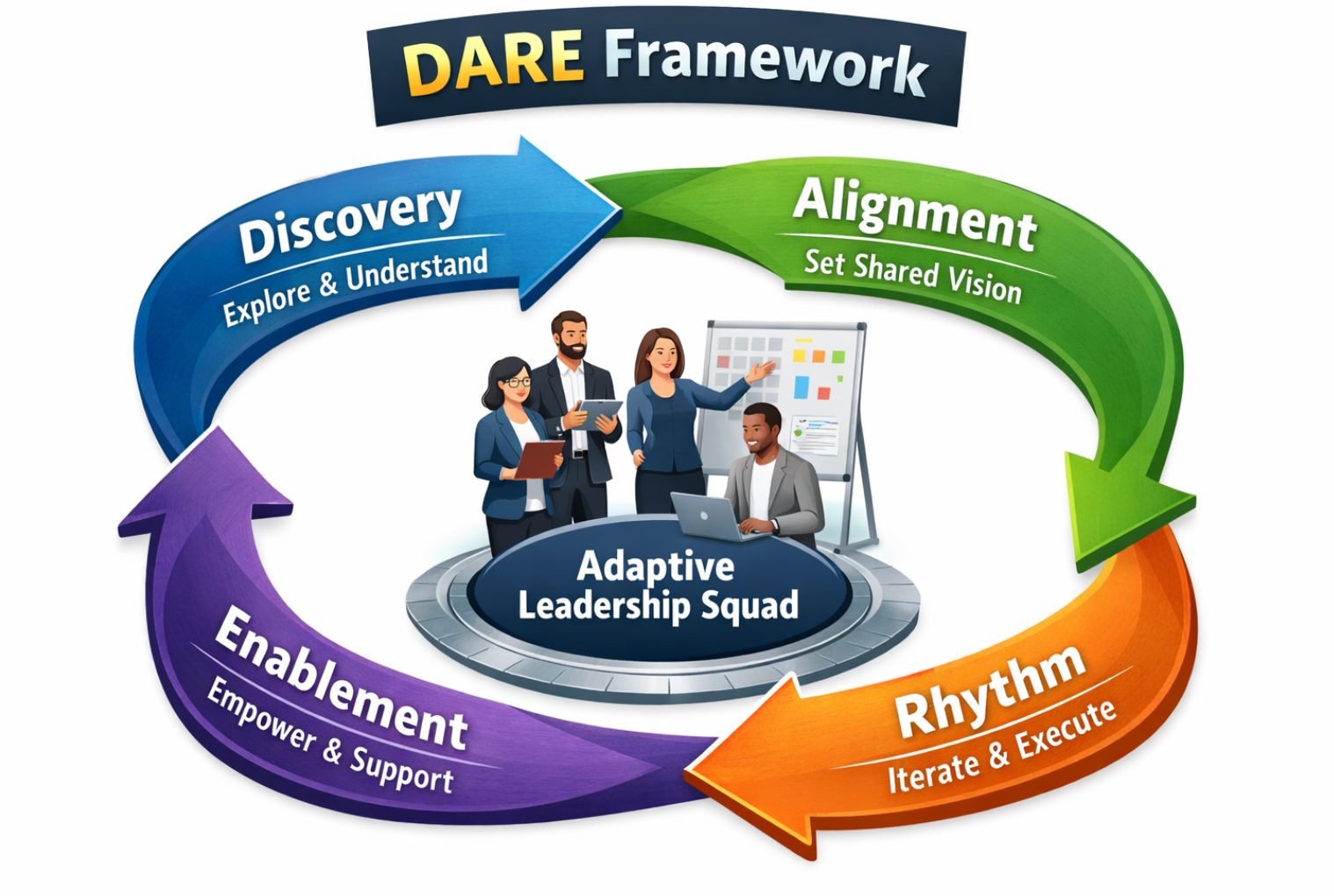
Discovery:
Explore & Understand
Their discovery included interviews and surveys across all levels, from SVP to entry-level, to understand perceptions and identify trends.
Alignment:
Set Shared Vision
They shared their findings with senior leadership, understood their vision, and co-created goals for an "Adaptive Leadership Squad" (Squad).
Rhythm:
Iterate & Execute
The Squad operated iteratively and like a scrum team with rotating roles (product owner, scrum master, developers) to ensure equal opportunity and shared ownership.
Enablement:
Empower & Support
All Squad members completed the Agility in Leadership™ training to establish a common language, mindset, and approach. Education was paired with one-on-one and group coaching to develop each individual.
A Working Agreement that Made All the Difference
Perhaps the most striking element was the Squad’s working agreement that enabled the DARE approach’s success—requirements so demanding that participation became a privilege, not an obligation:
- Prioritize Squad work over all other work items
- Challenge yourself to experiment and take actions beyond your comfort zone
- Commit to learn something new daily and dedicate 8-10 hours weekly for learning and sharing
- Operate with the highest integrity and treat every person with deep respect
- Express genuine curiosity about others' perspectives with a learning/serving mindset
- Deal with conflict head-on with a win-win mindset
"If you're not ready to follow these, you can't be part of the Squad," Rashmi explained. Leadership agreed: if people don't fit, don't force it.
Some left midway. But nine remained—coachable, groomable leaders who became the transformation catalysts. The Squad members were open to learning, willing to get out of their comfort zone, and committed to delivering their best to the cause.
Tom D. captured what resonated: "The commitment. You prioritize this above all else, and if you don't agree, you're not part of the group. It's voluntary, so you get buy-in, then you've got commitment."
Pete B. compared it to a special ops military team: "You have such a high bar of entry that it's elite and privileged to be part of it. Don't make it easy, make it hard—which might attract the right people."
That's exactly what happened. As results became visible, people came asking: "How can we join? What can we do to be part of this transformation?"
The Three Principles of Partnership
The DARE approach created structure, but a coaching partnership made it work. Rashmi and Kumaresh distilled their learning into three principles:
Principle #1: Practice (pIE: Performance + Image + Exposure)
Partnership requires more than collaboration—it demands co-creation built on credible internal leadership and trusted external coaching.
The pIE model emphasizes that image and exposure must be founded on performance. "We start with performance," Kumaresh explained. "The internal leader and external coach challenge each other for good performance. Once there's performance, there's scope for image and exposure—not the other way around."
The caution: Beware the "inverse pIE"—leaders with high visibility but low performance who appease leadership, showing up for audits but absent during customer crises.
Rashmi and Kumaresh exemplified this principle through complementary strengths. "I don't care about image and exposure—I just do my work," Rashmi admitted. "Kumaresh cares about image and exposure. Every time I did something that changed even a small thing, he would talk to SVPs and other leaders, giving me exposure. And when leaders asked me about coaching, I'd put Kumaresh on top, saying he's supporting me. We were constantly backing each other up across all layers of the organization."
Pete B. recognized the power: "What's surprising is each lifting up the other—the external lifting up the internal, the internal lifting up the external. That's the power of this partnership."
Principle #2: Perspective (External Insight + Internal Context = Meaningful Action)
External coaches bring insight undiluted by organizational politics. Internal leaders bring context about what's actually possible. Neither alone creates transformation.
"Insight becomes meaningless when it doesn't mix and match with organizational context," Kumaresh explained. "For insight to spark meaningful action, it must be contextualized."
The caution: Off-target and out of context. Without partnership, insights can get taken out of context.
Pete B. reframed it practically: "We have expertise as consultants that we bring into the company. The leader has expertise of what's inside. We're asking for a growth mindset from both to check expertise at the door—not leave it home, but put it aside enough to be open to how that expertise might apply."
Rashmi described enforcing this in Squads meetings: "We had a thing on screen that said 'leave your titles at the door.' We had senior leaders and entry-level people working together.” She shared that part of her role as coach was to “call them out when power dynamics emerged and say 'you can't say that—we are all equal here.'"
Principle #3: Progress (Working IN + Working ON the System = Holistic Transformation)
The transformation backlog must balance working in the system (value delivery) with working on the system (cultural transformation).
"At any point in time, the backlog must reflect what the organization needs," Kumaresh explained. "Sometimes there's urgency to deliver value this quarter—more 'in the system' elements. Next quarter with less urgency provides mind space to focus 'on the system.'"
The caution: Dropping either ball creates disaster—but differently. "If you drop the ball on working in the system, it's like a rubber ball that hits back immediately and hard. If you drop the ball on working on the system, it's like dropping a glass ball—it breaks, and it's very difficult to mend."
Steve O. appreciated the metaphor's severity: "I never thought of it being that disastrous if you let one strongly out of balance. The severity of letting one really be lost—I appreciate that emphasis."
Pete B. noted how coaches often overemphasize the system side: "What I'm seeing from leaders and employees is we don't have time—that pressure is growing every month to just get stuff done. I appreciate you bringing balance, helping them focus on delivering
in the system, not just improving it."
The Transformation: Three Major Impacts
Within 10 months—a timeframe that struck Tracey W. as remarkably fast for organizational change—they achieved:
- Culture of Mutual Respect - Direct feedback became encouraged, appreciation given openly, psychological safety established, and zero visibility transformed to complete transparency.
- 90% Reduction in Customer Escalations -The team shifted from "who has to handle this?" to working as one team focused on customers rather than internal conflicts.
- On-Time Major Release Without Quality Issues - Improved accountability enabled launching a significant feature release to market that helped the business grow by $100M.
The Individual Impact: Career Transformation and Organizational Ripple Effects
Beyond team results, the Squad members experienced profound personal growth that accelerated their careers and spread throughout the organization.
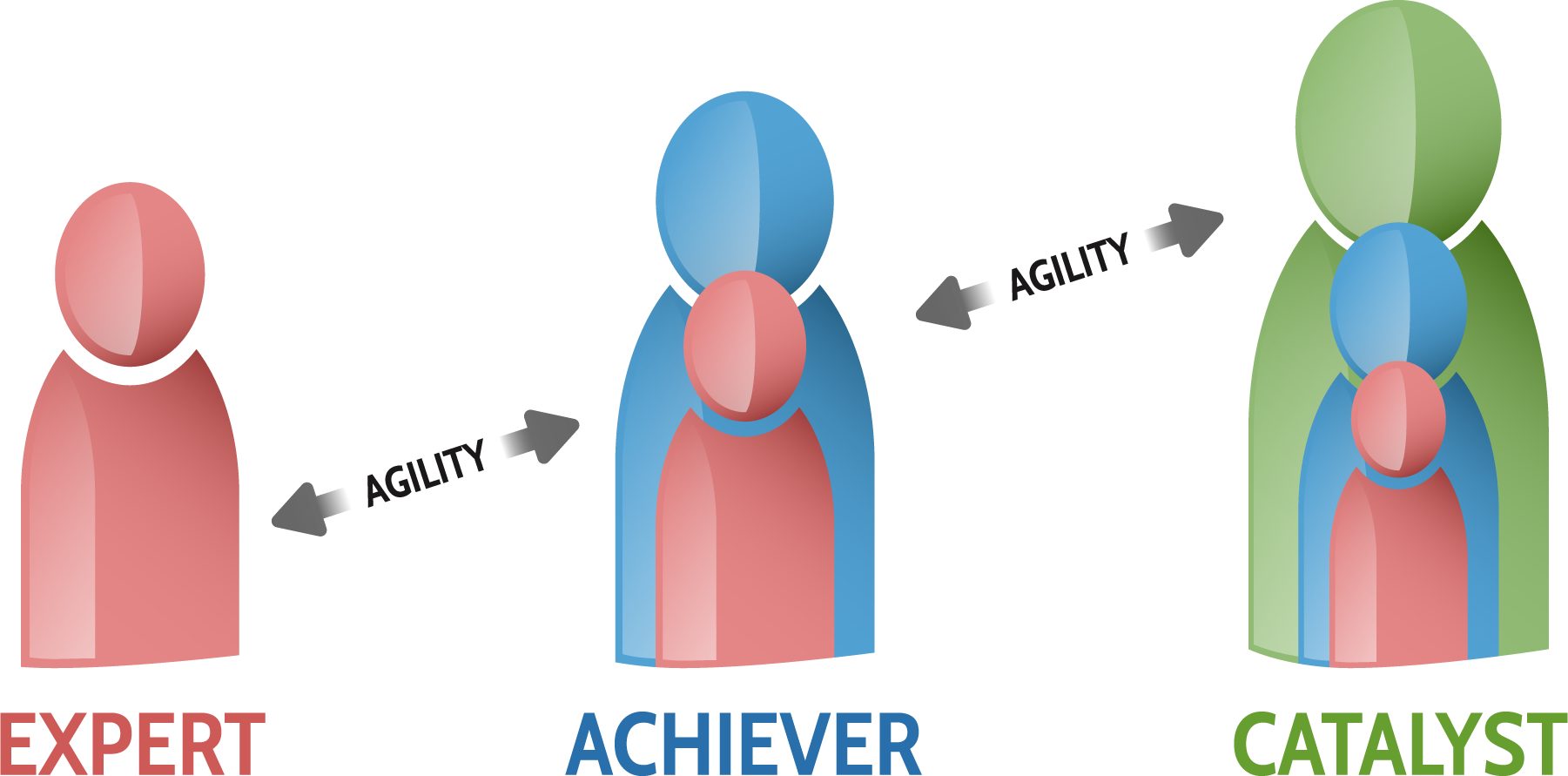
More than 50% of squad members received promotions. However, Kumaresh emphasized the deeper transformation: "We spoke about all of them carrying the Russian dolls within them.”
This concept of leadership agility that reflects that within the Catalyst leader remains the Achiever leader and the Expert leader. Being a Catalyst requires the ability to situationally adapt.
Kumaresh explained “They'd say 'in this situation I must be more Achiever than a Catalyst. No, I think in this situation I need to be a Catalyst. Now I need to wear my Expert hat.' You see the language evolving with the team—how they were making it more of a day-to-day choice. That was, I think, the key transformation which we could see with the team."
The self-leadership capabilities they developed became portable assets. Those who weren't promoted found better alignment—some moved from developer to product owner roles, others transitioned to positions that fit their evolved leadership identity.
One participant left the organization specifically to practice her new leadership approach: "I'm not able to practice what I'm feeling right now, and I want to be a better leader." She stayed in touch with Rashmi, reflecting that "those nine months were so crucial in their leadership journey.” The Squad members “feel if they hadn't done this exercise, they would have missed being better leaders."
Kumaresh himself was promoted twice.
This created a powerful ripple effect. As Squad members moved to new teams and contexts, they carried forward what they learned—language shifts like "team member" instead of "resources," normalization of conflict, psychological safety practices, and the win-win mindset. Leadership capabilities developed in the Squad became seeds planted throughout the organization, with potential to multiply the impact far beyond the original 75-person division.
The Human Details That Made It Work
Beyond the structure and principles, small practices created safety and spread change:
Language shifts: They normalized "conflict" as "disagreement"—no longer taboo. "People were saying 'oh we're going to have conflict.' We said 'no, it's just a disagreement—let's talk about it,'" Rashmi explained.
Humanizing language: Every time someone said "resources aren't doing the work," Rashmi and Kumaresh corrected: "Say team member." The nine squad members spread this across the organization. "When somebody used 'resources,' they'd say 'no, say team member.' It spread like wildfire."
Normalizing team development: Rashmi and Kumaresh introduced Tuckman's stages of group development, which explains that as teams develop in maturity and ability, relationships are established and leadership style changes to more collaborative or shared leadership. These stages are commonly known as Forming, Storming, Norming, Performing, and Adjourning. Using the model, the Squad made it safe to acknowledge observed stages: "Oh you're forming, you're norming right now, so it's okay to fight with each other." When someone left and someone new joined, "you're back to forming—you're going to have conflicts, and it's okay, talk about it."
The Challenge: It Can't Be Replicated Without Partnership
Rashmi was candid about limitations of the approach without solid partnership: "It's not like this is a book you can just go back and apply. We tried with another department—it didn't work because I didn't have a leader like Kumaresh who was as committed."
Sally T. asked if the partner could be in any position. "Yes, anybody," Rashmi confirmed. "Kumaresh wasn't an agile excellence leader. He was scrum of scrums master first. But he had influence because he'd been in the organization a long time and had connections. He used those to build image and exposure for me, to get buy-in, remove obstacles, make paths."
The partnership equation proved essential: Credible Internal Leadership + Trusted External Coaching = Powerful Partnership.
Pete B. captured the essence: "What I love about this story is the transformation of empowerment. An external comes in and what grows is these leaders inside the organization who create a difference. However small sometimes, it's personally transformative as well as team-level, department-level transformative—leaving something behind that's better than when we came."
What You Can Do Tomorrow
If your technically sound initiative is practically stuck:
- Name the human problem. Stop treating it as only a technical challenge. What partnership dynamics are missing?
- Assess your partnerships. Do you have complementary strengths? Are you lifting each other up? Is there mutual challenge and respect?
- Check for balance. Are you focused only on insight (external view) or only on context (internal reality)? Transformation requires both.
- Look at your backlog. Are you working only in the system or only on it? Both balls must stay in the air.
- Raise the bar. Consider making participation harder, not easier. Elite commitment attracts the right people.
- Start with discovery. Before jumping to solutions, understand perceptions across all levels.
- Create working agreements. Make expectations explicit. Let people opt out if they're not ready.
As Rashmi and Kumaresh concluded: "Approaches may guide the work of change, but it is partnership that carries it across the line."
Join the Conversation: The Agile Leadership Journey community continues to explore these challenges in monthly alumni masterclasses. If you're navigating initiatives that are technically sound but practically stuck, you're not alone. The breakthrough often emerges not from having the right answer, but from engaging the right relationships
Interested in developing partnership as a leadership practice? Explore our leadership development programs to build the capabilities that enable learning, shared accountability, and progress in complex systems.