
The Gap Between Knowing and Doing: Why Leadership Conversations Are Harder Than They Look
ARTICLE HIGHLIGHTS
Most leaders who have worked on their communication skills will tell you the same thing: they know what to do in difficult conversations, and they still don't do it consistently — especially in the leadership moments that matter most. Six specific traps — from assuming you understand before you do, to fixing what wasn't yours to fix, to resolving what was never going to resolve — catch even experienced leaders off guard, precisely when their best thinking is most needed. Closing the gap between knowing and doing isn't a knowledge problem. It's a practice problem, and the Catalyst Conversations™ approach offers a practical map for navigating it.
Why Leaders Struggle to Use What They Know
You've learned the approach. You've practiced it, maybe even taught it. And then the real conversation arrives. A conversation with stakes, with history, and with a person who isn't following your script. That’s when something else takes over entirely.
Pete Behrens shared in a recent conversation with a group of experienced leaders and coaches: "Regardless of the tool, regardless of our intent, regardless of how effective I could be — when it comes to the real conversations, meaningful conversations, important conversations, I'm not always showing up the way I intend to show up."
Behrens developed and teaches the Catalyst Conversations™ approach. His point was that expertise doesn't inoculate against this. Knowing the approach makes the gap more visible — you can see clearly where you fell into the trap — but it doesn't mean you avoided it. The gap between knowing and doing is persistent, and it's more honest to say so than to pretend the expertise alone closes it.
What IS the Catalyst Conversation™ Approach?
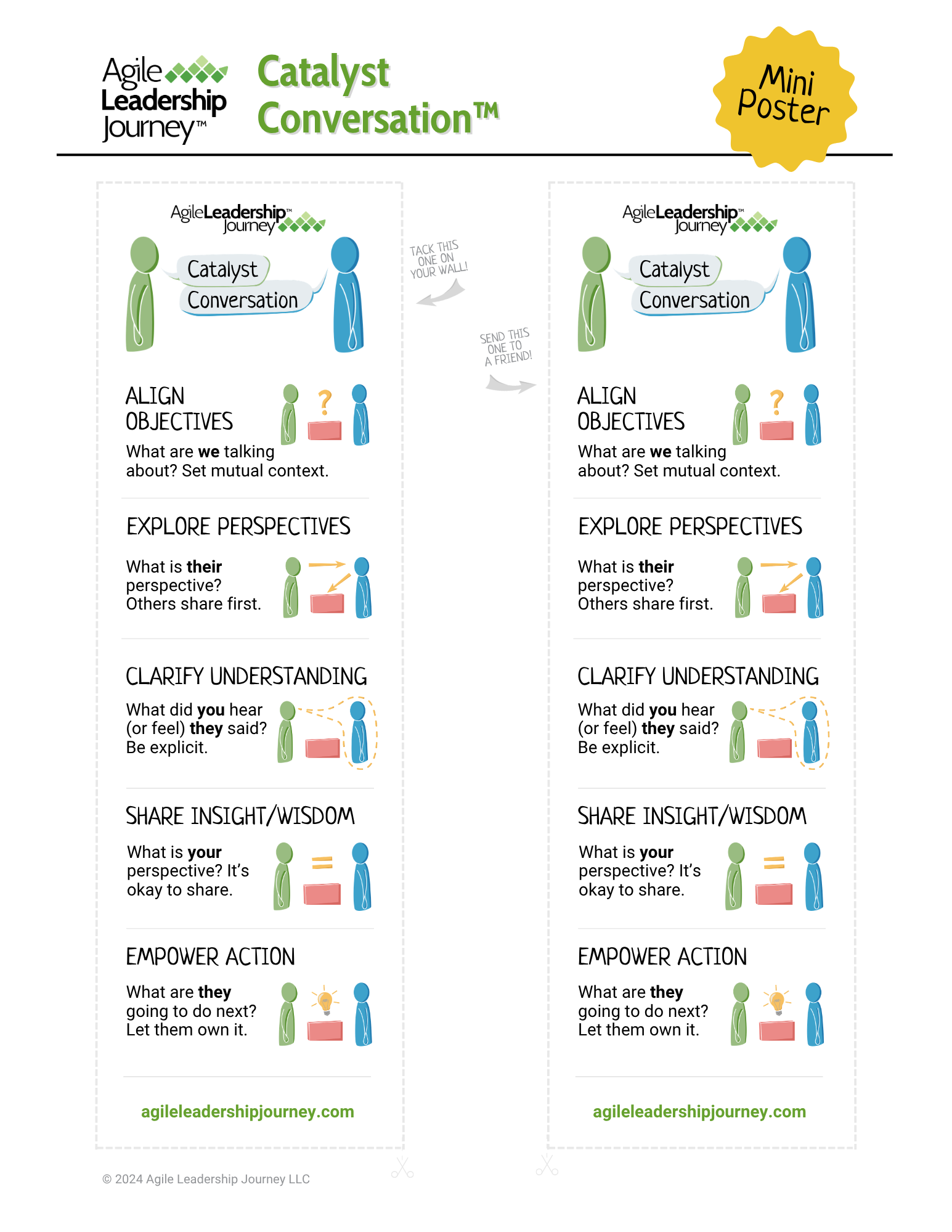
Catalyst Conversation™ is a communication approach developed by Pete Behrens, founder and CEO of Agile Leadership Journey, to reduce threat, increase psychological safety, and improve the outcomes of high-stakes professional conversations through five fluid orientations: Align Objectives, Explore Perspectives, Clarify Understanding, Share Insight/Wisdom, and Empower Action.
Before getting into where conversations go wrong, it helps to understand the structure designed to keep them on track.
Catalyst Conversation™ is an approach developed by Agile Leadership Journey to reduce threat, increase psychological safety, and improve the outcomes of any meaningful conversation. At its core are five orientations — not steps to follow in sequence, but intentions to move between fluidly as the conversation unfolds. Done well, it's less a checklist than a dance, dipping in and out of each as the moment calls for it.

Align Objectives
Establish mutual context before anything else. What are we here to talk about? What does each person need from this conversation? Skipping this is one of the most common reasons conversations drift or disappoint.
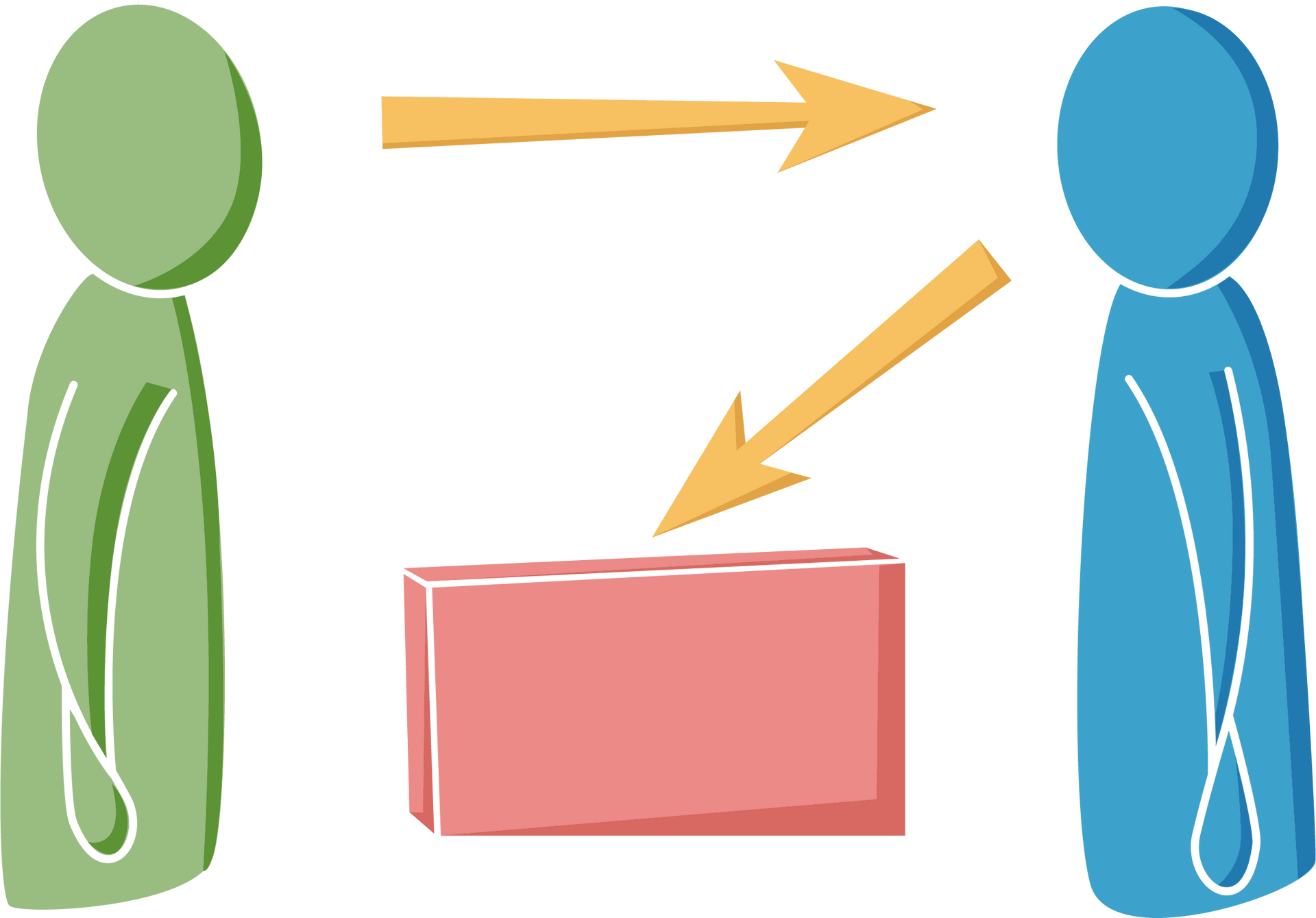
Explore Perspectives
Invite the other person to share their view first. What do they see? What matters to them? This orientation is deliberately accommodative — it resists the pull toward sharing your own position before genuinely understanding theirs.
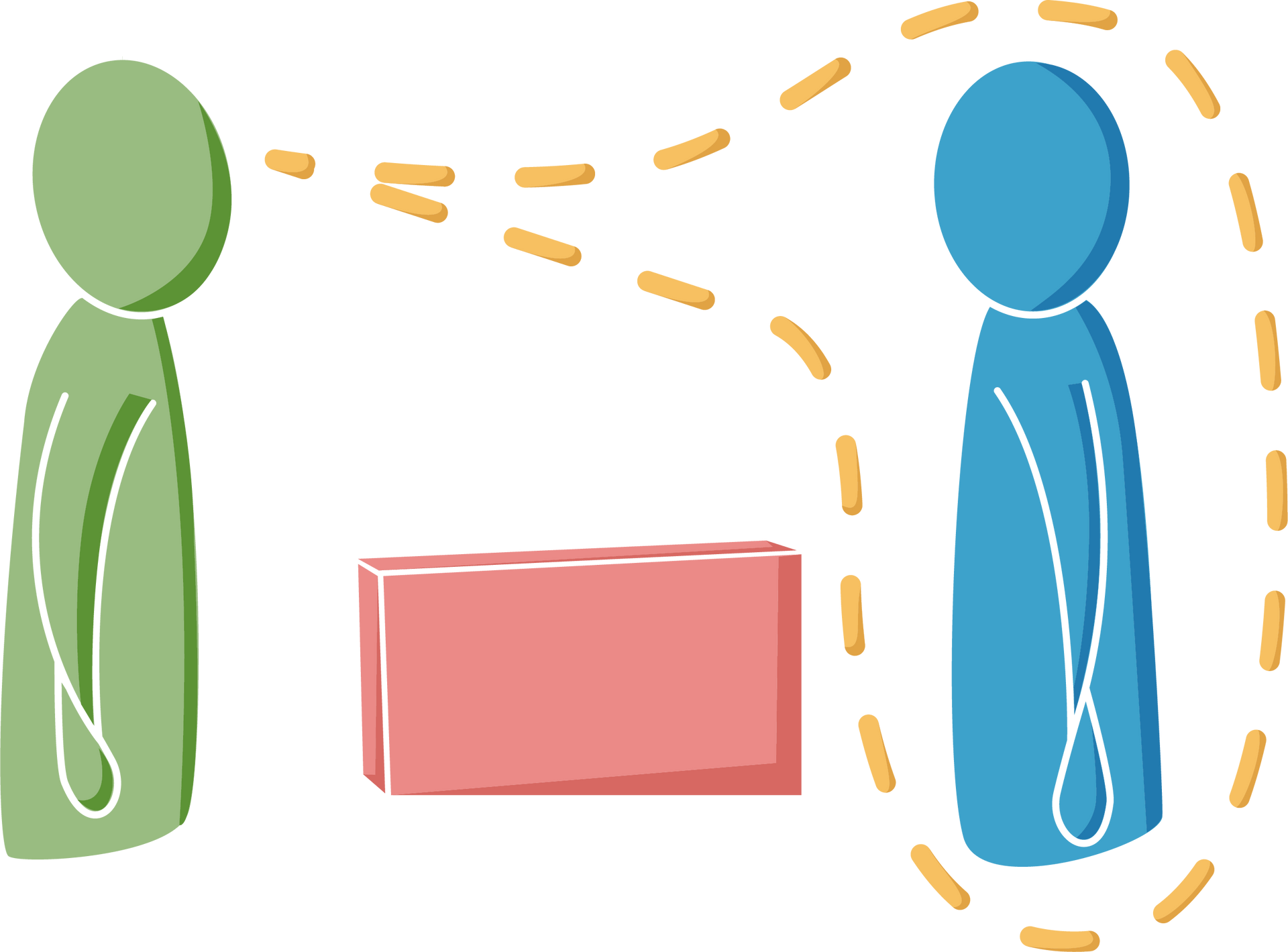
Clarify Understanding
This is where most conversations fall short. Clarifying isn't just listening — it's reflecting back what you heard, checking that your understanding matches their intent, and being explicit about what you took away.

Share Insight/Wisdom
Once you've genuinely understood their perspective, it's appropriate to share yours. This orientation gives the leader permission to have a point of view without taking over the conversation.

Empower Action
The close of a Catalyst Conversation™ belongs to the other person. What are they going to do next? Let them own it. The goal isn't a solution the leader hands over — it's a next step the other person has chosen.
These five orientations provide the map for more effective communication. What the rest of this post explores is why experienced leaders — even people who know this map — still struggle to use it in the moments that matter most.
Why Meaningful Conversations Are Threat-Prone by Default
When something real is at stake, the brain registers a threat. And threat doesn't just distort conversations — it prevents them from happening in the first place. Leaders veer away from what they intended to say. They smooth things over. They leave the real issue unspoken and walk away with the uncomfortable sense that they missed an opportunity.
Across two decades of polling thousands of workers, Christine Porath of Georgetown University found that 98% report experiencing uncivil behavior at work and 99% report witnessing it — suggesting that threat-laden interactions are essentially universal in organizational life (Porath, Harvard Business Review, 2016). Research on negativity bias compounds the challenge: negative events, emotions, and feedback are more powerful and durable than their positive equivalents across nearly every domain studied (Baumeister, Bratslavsky, Finkenauer & Vohs, 2001). David Rock’s SCARF® model — which identifies Status, Certainty, Autonomy, Relatedness, and Fairness as the five domains most likely to trigger a threat response — helps explain why (Rock, 2008). Nine things can go right in a conversation, and one status threat will define the memory of it.
This means that no matter how carefully a conversation is structured, a single moment of perceived slight — a word that landed wrong, a tone that triggered something old — can collapse what was otherwise well-intended. Often, the person invoking the threat has no idea.
When a group of experienced leaders and coaches were asked what makes meaningful conversations feel risky, their answers spread across a familiar landscape: lack of safety, unclear roles, not wanting to offend anyone, time pressure, lack of certainty or autonomy, political climate and clout, the other person's agenda. Leadership coach Josh Forman noticed something in that list: nearly every response pointed outward — at the other person, the situation, the conditions. Very few pointed inward.
"What if we're not open enough?" Forman asked. "Certainly, we have an agenda. Everybody has an agenda of some kind. We can hold it loosely, but just notice how we're bringing ourselves to conversations."
Behrens picked up the thread: "What is our threat? What is our fear? What is our ego? What is our ability to be honest with ourselves?"
The external conditions are real. But a leader's own state, assumptions, and blind spots are equally real, and considerably more within reach.
Power dynamics add another layer. Forman observed that threat amplifies when positional authority is present — the person with less power may experience a neutral comment as significant, while the person with more power registers nothing unusual. "Status threat is so critical," Behrens noted, "and it comes with us whether we intend it or not." The leader who enters a conversation with the best of intentions still carries their position into the room. For senior leaders, especially, the lightest comment can land with the weight of a directive. People don't see your intent. They see your behavior.
The Communication Traps That Catch Even Experienced Leaders
Several specific traps surface repeatedly in meaningful conversations — in leadership coaching sessions, in performance conversations, in the high-stakes exchanges leaders need to get right — even among leaders and coaches who know what to watch for. Naming them as traps can help — not to assign blame, but because recognizing the pattern in the moment is the only way to do something different.
1. The Assumption Trap
Conversations rarely stay exactly where they started. Someone says something and something in the listener's mind clicks — I know what this is — and the mode shifts from listening to processing. The conversation the leader thinks they're having and the conversation actually happening quietly diverge.
Forman described the moment of transition: "This happens when we stop listening, when we start to rehearse what we're going to say next rather than continuing to listen to what the other person is saying." Behrens added that the shift is often unmistakable in retrospect: something triggers recognition and the listener moves from open to certain in an instant.
Rashmi Fernandes, drawing on her coaching experience, identified a subtler version — the discomfort of silence. When someone is thinking and the pause stretches out, the impulse to fill it with what seems obvious is strong. It feels helpful. It's often wrong.
Another leader in attendance named the most well-intentioned version of the trap: assuming the other person's pain is your pain. A seemingly empathetic response — "Oh, I know exactly how you feel" — can close down a conversation by substituting your experience for theirs, even when the feeling behind it is genuine. For mid-level leaders under time pressure, this trap is particularly common — the instinct to get to understanding quickly leads to performing understanding instead.
A coach working within an organization described a technique that surfaced the trap clearly: a client had made the same point five different ways, each a variation on the same frustration. She asked them to collapse it into one statement. "It turned out to be four words. And they said, 'Man, I just made that more exhausting. Why couldn't I have started with these four words?'
The Pivot: Catch the click.
The tell is internal: that small snap of recognition when your mind slides from listening to I know what this is. Learn to feel that click as a signal, not a verdict. When it fires, set your certainty down and step back into their frame — look at the problem from their lens rather than asking another question about it. And if the conversation has quietly drifted, name it: "We said we'd focus on X; I feel us moving toward Y. Is that right?" Naming the drift hands the map back to them — and often reveals the drift itself was the point.
2. The Inquiry Trap
Leaders and coaches — particularly those doing leadership coaching work — are trained to ask questions. The instinct is right — questions create space, demonstrate curiosity, and keep the focus on the other person. The trap is in the accumulation.
"It's exhausting," a leader said. "I feel like I'm on trial."
Behrens observed a dynamic beneath the discomfort: excessive questioning can subtly position the person asking as above the conversation. "It assumes: I'm just here to ask the questions and you're doing all the work. Most questions are subservient — they gift time to the other individual — but they can also turn the relationship into something unbalanced."
Fernandes added a more personal version: she had worked with a leader who asked the same question many different ways because he believed the other person needed more clarity, based on how he himself had struggled with similar issues. His intention was to help. His impact was to impose his own belief system on the conversation, treating the other person's need as a mirror of his own. Mid-level leaders, often caught between strategic directives and team execution, are particularly susceptible to this — the pressure to be seen as value-adding can tip question-asking into interrogation.
Another coach described his practice, a commonly used one: taking detailed notes during a conversation, then reflecting back exactly what was said. "I heard you say... am I on the right track?" The reflection makes the other person feel they are leading, not being led.
The Pivot: Trade the next question for a mirror.
The tell is the reach — the reflex to have another question loaded, as if a pause you don't fill is a failure. Notice that reach and resist it. Instead of a new question, go deeper into the last one: "Tell me more" is an invitation, not an interrogation. Or drop the questions entirely and reflect — "Here's what I heard you say. Am I on the right track?" Mirroring makes them feel they're leading you, not being led. A question asked to fill space puts you above the conversation; a reflection offered puts you beside them.
3. The Listening Trap
Most leaders believe they are listening when they are doing something adjacent to it — waiting, formulating, nodding — while believing themselves to be fully present.
A leader described a pattern: arriving with a preloaded answer and nodding through the explanation until the moment comes to deliver it. The listening was selective; the conclusion was already formed.
Listening is only one part of a comprehension process. What follows it matters just as much: reflecting back, checking understanding, naming what you heard before moving forward. As Behrens put it: "Clarifying understanding means there are multiple steps to this. It's listening and processing and aligning with others." The nod, the verbal affirmation, the mmhm — these are weak signals. Real listening is an interactive process.
Fernandes recalled a leader whose physical presence changed how heard she felt — someone who leaned forward, sat at the edge of their chair when she was talking. No special technique. Just a body that said: this matters. "It's not just your voice," she said. "It's also your body language."
In virtual settings, these signals are harder to give and easier to fake. One leader described setting explicit expectations at the start of every session: minimize distractions, keep hands visible, create the conditions that make real presence possible. Not because the other person will always honor them — but because naming them shifts the quality of attention on both sides.
The Pivot: Close the Loop.
The tell is believing that because you're quiet and taking it all in, you're listening — mistaking absorption for connection. But listening isn't a bucket you fill; it's a loop the other person has to feel closing. If they can't tell their words are landing, you're not listening — you're just receiving. So participate: lean in, sit at the edge of the chair, let your face and body carry this matters. Virtually, where presence is easy to lose, make it deliberate — camera on, distractions closed. Real listening is something both people can feel happening, not a stillness one of them performs.
4. The Fixer Trap
The instinct to help is one of the things that draws people to coaching and leadership in the first place. It's also one of the most reliable sources of conversations that don't go where they needed to go.
A coach in the group provided the most direct version of how he learned this: "My wife broke me of it really quick. She's like, 'I'm not talking to you for you to fix stuff. I just want somebody to listen.'" That lesson, he said, has shaped his coaching more than most formal training.
Fernandes identified two drivers beneath the fixer instinct. The first is a sense of worth tied to being the person with the answer — the identity of problem-solver is hard to set aside when it's been rewarded. The second is more immediate: discomfort with the other person's distress. "You genuinely want to help, but you don't see that by helping you're not empowering them. You're just giving them a short-term fix." Behrens added: "You're trying to avoid their pain."
This trap hits hard for leaders who were promoted because of their individual expertise — the very instinct that made them successful as individual contributors becomes the thing that limits them as leaders. Research supports the concern: a study by Kluger and DeNisi (1996) found that more than a third of feedback interventions actually decreased performance — specifically when feedback pulled attention toward the self rather than the task. Intent and impact come apart.
One leader described a question he now asks at the start of conversations with his team, drawing on Brené Brown's principle that empathy begins with understanding what kind of support someone actually needs: "Do you need me to listen? Do you need me to help? Or do you need me to grab a shovel?" The ask does two things — it signals genuine attention to what the person actually needs, and it gives the leader permission to stay in listening mode when that's what's called for.
The Pivot: Notice whose discomfort you're solving.
The tell is subtle: the urge to fix usually rises to relieve your discomfort at their distress, not theirs. When you feel yourself reaching for the cape, pause and ask whose pain you're reaching for. Then hand the choice back — "Do you need me to listen, help, or grab a shovel?" That one question keeps you from solving a problem they only wanted witnessed. And sometimes the most useful move is a mirror, not a fix: "Sounds like you've got a hold of this already." You can't help anyone who hasn't chosen it — you can only get them to the water.
5. The Resolution Trap
Related to fixing but distinct from it, the resolution trap is about ownership more than action — the impulse not just to solve the problem but to take responsibility for it.
Fernandes identified what gets lost: "You're stealing away an opportunity for someone to grow because you're giving the solution and resolving it for them instead of them being able to come up with it." As another leader shared, there’s an organizational version of this dynamic: the leader who becomes so reliably the person who figures things out that others stop developing the capacity to do so themselves.
John Gottman's decades of longitudinal data on relationship conflict found that 69% of conflicts are perpetual — rooted in enduring differences that won't be solved (cited in Psychology Today, 2025). Not won't be solved today. Won't be solved. If resolution isn't a realistic goal for most meaningful conflicts, the measure of a successful conversation has to shift. "Maybe my ask for this conversation is reduced," Behrens said. "Maybe it's more about a next step in the relationship than solving this tactical problem."
Fernandes connected this to a useful distinction in conflict research, originally developed by organizational psychologist Karen Jehn: when the focus stays on the task or objective rather than the relationship or ego, conversations can move toward progress even when the underlying difference remains (Jehn, 1995). Adam Grant later brought Jehn’s research to a broader leadership audience in Think Again (2021), distinguishing between relationship conflict — personal and emotional, layering animosity on top of friction — and task conflict, which involves clashes about ideas and opinions but isn't personal. Both point back to Kluger and DeNisi's finding: when attention moves toward the self, effectiveness drops. Keep it on the work.
Catalyst Conversations™ are not about resolving issues. They're about empowering the next step toward them.
The Pivot: Shrink the ask.
The tell is the need to walk away with it closed — solved, owned, done. But Gottman cuts against that: most meaningful conflict is perpetual and won't be resolved in one sitting, maybe ever. When you feel yourself reaching for resolution, lower the bar on purpose — ask not whether the issue is fixed but whether the relationship is better positioned for the next conversation. And when they push, "Well, what would you do?", don't grab it. Offer the dance: "I've got some thoughts I'll share, but you go first, then let's build on it." Own the next step together; don't own the outcome for them.
6. The Silence Trap
Fernandes added a sixth trap: sitting in silence as a deliberate technique, offering nothing, and waiting for the other person to arrive at their own answer.
The distinction worth making here is between two very different kinds of silence. Generative silence — pausing after a meaningful question, giving someone genuine room to process a hard thought — is a powerful tool for psychological safety. Withholding silence — offering nothing, asking nothing, simply waiting as a technique — can feel like a test, cold and unhelpful rather than spacious. Fernandes described the latter from her own experience as a coaching client: "He just sat there. I didn't have questions, I didn't have anything. 'Take your time, you'll figure it out.' It was very weird and not so effective."
Any technique applied without genuine attunement to the person in front of you becomes a performance rather than a conversation. The person in the room always matters more than the method.
The Pivot: Ask who the silence is for.
Sometimes we go quiet because we think good coaches are supposed to. Sit back, say nothing, wait for them to get there on their own. But silence held as a technique reads as a test, not a gift. So when you catch yourself sitting in it, check who it's serving. A pause after a real question gives someone room to think. A pause you're holding to seem wise just leaves them alone in the room.
Where conversations break down
Different leaders hit walls at different points in a conversation — and often not the ones they'd predict. The opening, middle, and closing each carry distinct failure modes.
| CONVERSATION PHASE | THE HIDDEN DANGER | THE PIVOT |
|---|---|---|
| The Opening | Entering with unaligned, unspoken assumptions. | Slow down: align explicitly on the conversation’s purpose before diving in |
| The Middle | Rushing to action before fully exploring perspectives | Stay present: resist the urge to resolve; focus on understanding their experience first |
| The Closing | Commitments evaporate; actions lack real ownership | Empower ownership: focus on relationship health and a meaningful next step owned by them |
A leader and internal ALJ Guide at a global supply chain organization, Tünde Siliga, described the middle pressure most directly from her experience in high-pressure corporate environments: "We tend to jump to the action immediately. We are socialized to take action immediately."
Another leader expressed more challenges in closing: "No matter what I do, they just don't want to take any actions." Behrens pointed back to Gottman — sometimes the appropriate close isn't a specific action but a better quality of relationship that makes the next conversation possible.
How to Get Better at Catalyst Conversations™
Behrens offered a practical suggestion: "Especially when you're in conversations that are less stressful, using a Catalyst Conversations™ technique can actually be helpful — because it's teaching you how to do it under lower stress. So then when you're in these higher stress situations, it's just a little easier."
The repetition happens in smaller moments — the coaching conversation with a direct report, the peer check-in, the one-on-one where the relationship is stable. These are the everyday opportunities to build the communication skills leaders need most when the stakes are highest, whether at work or at home.
"Catalyst Conversations™ is simply a tool," Behrens said. "It's an aid to remind you of some of the things to try, to avoid some of these traps. It's a technique to reduce threat and increase reward, but it's not guaranteed. Any meaningful conversation will bring those out."
Download a Free Catalyst Conversation™ Reference Tool
Keep this quick-reference framework on hand to consistently practice and build the critical leadership communication skills needed to navigate difficult workplace conversations with confidence.
Ready to close the gap between knowing how to communicate and actually doing it when it matters most?
Go deeper on the Catalyst Conversation™ approach.
Explore our three-part Relearning Leadership podcast series on "How to Make Every Conversation Better":
Assess where you’re at.
Understanding where you currently lead from is the starting point. A personalized
360 assessment gives you the honest, structured feedback that makes self-awareness possible.
References
Baumeister, R.F., Bratslavsky, E., Finkenauer, C., & Vohs, K.D. (2001). Bad is stronger than good. Review of General Psychology, 5(4), 323–370. https://journals.sagepub.com/doi/abs/10.1037/1089-2680.5.4.323
Brown, B. (2012). Daring Greatly: How the Courage to Be Vulnerable Transforms the Way We Live, Love, Parent, and Lead. Gotham Books.
Jehn, K.A. (1995). A multimethod examination of the benefits and detriments of intragroup conflict. Administrative Science Quarterly, 40(2), 256–282. https://www.jstor.org/stable/2393638
Gottman, J. (cited in Psychology Today, 2025). Why 69% of couples' conflict will never go away. https://www.psychologytoday.com/us/blog/social-instincts/202512/why-69-percent-of-couples-conflict-will-never-go-away
Grant, A. (2021). Think Again: The Power of Knowing What You Don't Know. Viking.
Kluger, A.N., & DeNisi, A. (1996). The effects of feedback interventions on performance. Psychological Bulletin, 119(2), 254–284. https://www.researchgate.net/publication/232458848
Porath, C. (2016). An antidote to incivility. Harvard Business Review. https://hbr.org/2016/04/an-antidote-to-incivility
Rock, D. (2008). SCARF: A brain-based model for collaborating with and influencing others. NeuroLeadership Journal, 1, 1–9.
https://neuroleadership.com/portfolio-items/scarf-a-brain-based-model-for-collaborating-with-and-influencing-others/