
What is Catalyst Leadership?
ARTICLE HIGHLIGHTS
Most leaders are trained to have the answers — catalyst leaders are trained to ask better questions. Grounded in decades of research on how leaders develop, catalyst leadership represents a fundamental shift in how a leader sees their role: from driving results personally to developing the people and culture that produce them. Understanding this shift is one of the most clarifying — and challenging — steps a leader can take.
Catalyst leadership is an orientation — a way of seeing and approaching your role — in which your primary focus shifts from driving results through your own expertise and authority to building the people, teams, and culture that make great results possible. Catalyst leadership is most needed when the path isn't clear — where complexity makes control an illusion, uncertainty makes expertise insufficient, and the instinct to take charge is often the very thing that slows everything down. It's less about what you personally produce and more about what you make possible for others.
That's a meaningful distinction, and for many leaders, an uncomfortable one. Most of us built our careers on knowing things, solving problems, and executing well. Catalyst leadership asks you to hold those strengths more lightly and develop a different set of capabilities — ones that are harder to see but ultimately more powerful in complex, fast-moving environments.
Where Does the Term Catalyst Leadership Come From?
The word "catalyst" comes from chemistry. A catalyst is an agent that enables or accelerates a reaction without being the reaction itself. It's a useful metaphor for leadership — with one important caveat.
In chemistry, a catalyst remains unchanged by the process it initiates. In organizations, that's not how it works. As Pete Behrens writes in Into the Fog (2025), a catalyst leader "fundamentally is a leader who can and does foster change in themselves and their organizations." The internal shift comes first. The organizational shift follows.
The concept is grounded in the research of Bill Joiner and Stephen Josephs, whose award-winning book
Leadership Agility (2007) drew on a multi-year study examining the behaviors and thought processes of hundreds of managers. Joiner identified
a developmental progression of leadership orientations — Expert, Achiever, and Catalyst — each representing a greater capacity to lead effectively under conditions of complexity and change. Agile Leadership Journey's programs draw directly on this research as a core foundation.
Why Is Catalyst Leadership So Relevant Right Now?
Behrens grounds the relevance of catalyst leadership in a specific context: the leaders and leadership teams navigating complexity and uncertainty – where the old maps don’t work, the path isn’t clear, and the instinct to take control is often the thing that slows everything down. That’s the terrain where catalyst leadership isn’t just preferable. It’s necessary.
Every major shift in how we organize and lead work over the past century has been pointing toward catalyst leadership — and yet most organizations have yet to fully realize it.
Each wave of progress asked leaders to extend more trust, cede more control, and invest more deliberately in the people around them. Each time, organizations that fully made the shift gained a real and lasting advantage. And each time, many leaders adopted the surface behaviors without changing the underlying mindset that drives them — copying practices without internalizing the philosophy.
We are now in the middle of another wave. As Behrens observes in Into the Fog, generative AI is not just changing how work gets done; it's changing what work is. And as he puts it: "the real challenge isn't the next wave of technology. It's the new leadership mindset required to leverage the wave effectively."
That mindset is catalyst leadership. Not because it's new, but because the conditions that make it necessary have become unavoidable. High complexity, rapid change, and work that requires coordination across boundaries are no longer occasional challenges — they are the baseline for leaders across industries and at every organizational level.
A Quick Look Back at the Management Shifts That Brought Us Here
Frederick Winslow Taylor's scientific management — the dominant model of the early 20th century — was built on a clear premise: put thinking in the hands of managers, execution in the hands of workers, and optimize every step. At the time, it produced extraordinary efficiency but also led to worker disengagement, quality failures at scale, and organizations too rigid to adapt as complexity grew.
Lean manufacturing, pioneered by Toyota and shaped by the principles of W. Edwards Deming, was the response. Built on the belief that workers closest to the work — knowledgeable, respected, empowered — would outperform a management-driven system. As Behrens writes in Into the Fog, there was a recurring catch: "managers had to let go of control for it to work. Many didn't."
A generation later, Agile emerged to solve the same problem in a growing field of software development. Rigid, plan-driven approaches couldn't keep pace with the speed and complexity of building digital products. Agile handed more control to cross-functional, collaborative teams — and again produced compelling results where genuinely adopted. And again, as Behrens notes, "managers had to let go of control for it to work. And once again, many didn't."
For a deeper dive, check out
How Did Agile Leadership Emerge?
How Does Catalyst Leadership Differ from Other Leadership Mindsets?
To understand what's distinct about catalyst leadership, it helps to see what it builds on. Joiner's
leadership agility research identifies three orientations (combinations of mindsets and behaviors) that account for the leadership levels of the vast majority of leaders in today's workforce.
The Expert Leader
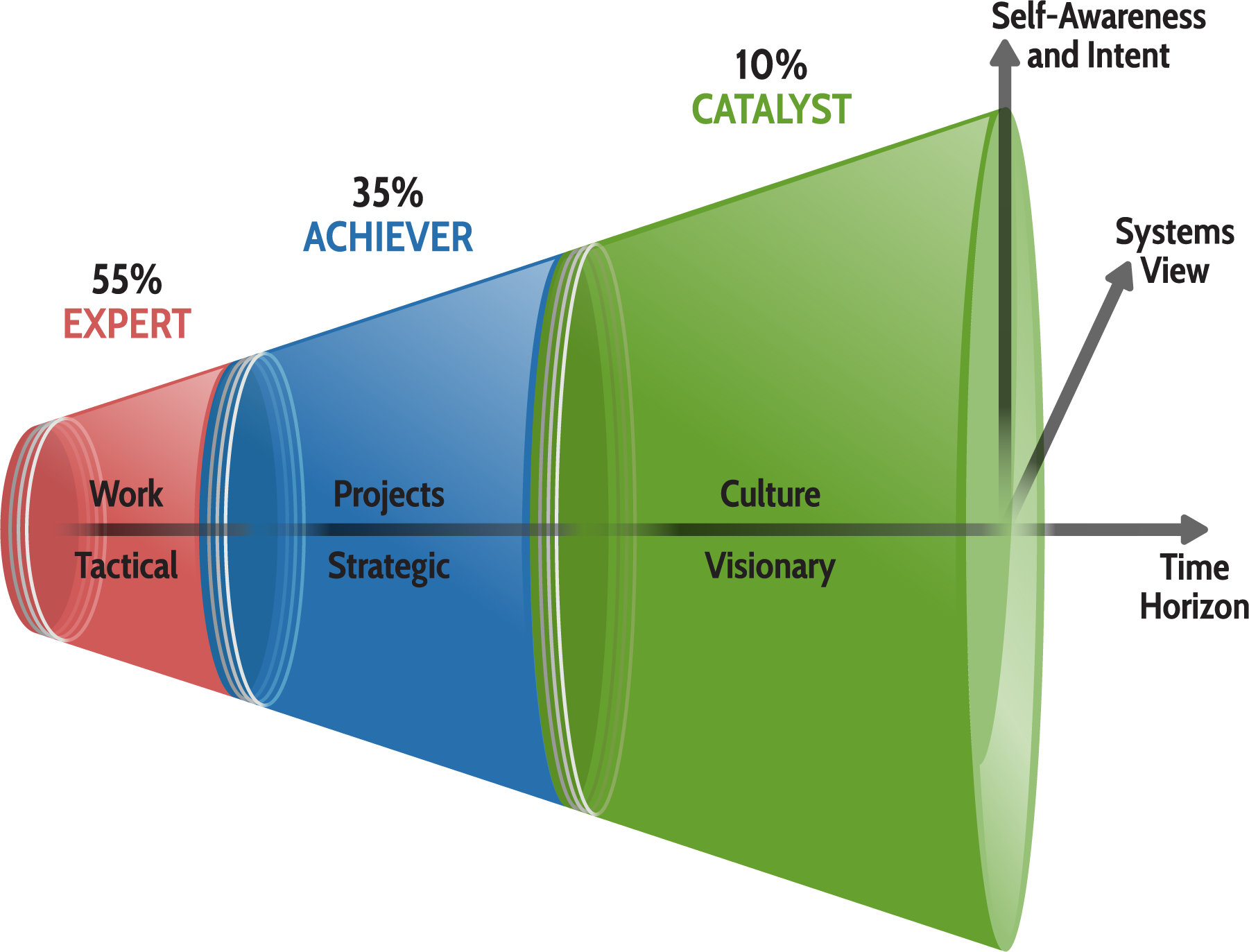
The Expert leads through knowledge and authority. This is a tactical, problem-solving orientation — leaders earn respect through expertise and direct their energy toward making things work within their area of responsibility. Expert leadership is well-suited for relatively stable environments where success comes through incremental improvement. It's where most leaders start, and it's genuinely valuable. Every organization needs people who know their craft deeply.
The Achiever Leader
The Achiever leads through strategy and results. This is a strategic, outcome-focused orientation — Achiever leaders motivate others by connecting them to larger objectives, work to align stakeholders across functions, and excel at cross-functional execution. Achiever leadership performs well in environments with moderate complexity and episodic change. It's the dominant orientation in most organizations, and for good reason: it produces results when the direction is reasonably clear.
The Catalyst Leader
The Catalyst leads through vision and empowerment. Joiner describes this as a visionary, facilitative orientation — Catalyst leaders articulate an inspiring direction and bring together the right people to pursue it. Their focus is on developing empowered organizations and teams capable of sustained success, ones that foster both personal and professional growth. The Catalyst orientation, Joiner's research concludes, is the most effective for today's rapidly changing, highly complex environments.
As Behrens puts it:
"Expert leaders focus on the work itself. Achiever leaders focus on the coordination of people and work, performance, and results. Catalyst leaders focus on the health of the whole system — the culture, the growth, the long-term resilience of the organization."

Each orientation builds on the previous one rather than replacing it. A Catalyst leader retains their expertise and drive for results — what changes is where their primary energy and attention live.
Joiner describes Expert and Achiever leaders as operating from a "heroic" mindset — assuming primary personal responsibility for setting direction and managing performance. Catalyst leaders operate from what he calls a "post-heroic" orientation: they retain ultimate accountability, but they create environments characterized by high involvement and shared responsibility.
How Is Catalyst Leadership Different from Servant Leadership?
The two share important common ground. Servant leadership, as Robert Greenleaf introduced it in 1970, places the growth and well-being of others at the center of a leader's purpose. That intent is genuinely aligned with a catalyst orientation. If you identify with servant leadership, you're likely already working from some of the same instincts.
The distinction lies in balance and scope.
Behrens differentiates the two:
"Servant leadership asks you to put others first — and that instinct is good. But catalyst leadership asks you to do that and still show up fully yourself. Stepping back feels humble. But sometimes your team needs you to step in, hold the tension, and lead. The best catalyst leaders I've worked with don't choose between serving and leading. They've learned to do both."
There's also a difference in scope. Servant leadership focuses on the relationship between a leader and the individuals in front of them. Catalyst leadership extends to the broader system — the culture, the conditions for learning, and the organization's long-term capacity to grow and adapt.
What Does the Shift Toward Catalyst Leadership Actually Require?
The transition toward catalyst leadership can be disorienting. Not because the concepts are hard to understand, but because they ask you to loosen your grip on the very things that made you successful — the skills, instincts, and identities that got you here. That's not a learning challenge. It's a personal one.
Moving toward a Catalyst orientation involves genuine shifts in how you see yourself, how you see others, and how you see the scope of your role. Moving toward a Catalyst orientation isn't simply a matter of adding new techniques. It involves genuine mindset and behavioral shifts that develop over time.
From Unintentional to Self-Aware
This is where the shift begins and without it, none of the other shifts are possible. Catalyst leadership requires the ability to see yourself clearly: to notice the mindset you’re operating from in a given moment, recognize when your default instincts are serving the situation and when they aren’t, and make deliberate choices rather than habitual ones. Behrens maintains that situational adaptiveness – the ability to flex across leadership orientations – depends entirely on self-awareness. Without it, there is nothing to adapt from.
From "I" to "We"
Expert and Achiever leaders often function as the hub that information and decisions flow through. Catalyst leaders deliberately move off that hub – and this goes deeper than communication style. Behrens suggests that it represents a reorientation of a leader’s relationship to power. Mary Parker Follett, whose work on organizational dynamics has influenced leadership thinking for a nearly a century, drew a distinction between “power-over” and “power-with” – the difference between power used to direct and control, and power generated through genuine collaboration. Drawing from Follett, Behrens holds that catalyst leaders relate to power differently; they learn to shift from the “power-over” to “power-with”. They build environments where teams connect directly with each other, share information broadly, and solve problems without routing everything through the leader.
From Immediacy to Resiliency
As leaders develop from Expert to Achiever to Catalyst, their time and focus shifts by expanding more broadly like a wide-angle camera lens. Expert leaders naturally focus on what needs to get done: the immediate task, the urgent problem. Achiever leaders extend that focus to strategic goals and outcomes – where are we headed and how do we get there? Catalyst leaders extend it further still, to the broader horizon: what kind of organization are we building, and will it still be healthy and capable five years from now? This shift in focus and time is one of the most practical expressions of a Catalyst mindset. As Behrens points out, this shift is one of the hardest to make in organizations that reward this quarter’s results over long-term health.
From Duality to Multiplicity
Expert and Achiever leaders tend to work in binaries: right or wrong, on budget or over, winning or losing. That's an efficient way to navigate clear-cut decisions. Complex challenges, though, rarely fit neatly into two options. Catalyst leaders develop the capacity to hold competing perspectives simultaneously, look for possibilities beyond the obvious two, and actively seek out diverse viewpoints rather than converging too quickly. As Joiner notes in his research, Catalyst leaders seek stakeholder input not simply to gain buy-in, but because they genuinely believe diverse dialogue improves the quality of decisions — a meaningfully different orientation than consultation as a formality.
From Protecting What's Right to Exploring What's Wrong
Expert and Achiever leaders are often invested in defending the approaches that brought them success — which makes sense, because those approaches earned them credibility. Catalyst leaders cultivate a different habit: genuine curiosity about what isn't working, including within themselves. As Behrens puts it, expert and achiever-oriented leaders are often consumed with protecting what is right, while catalyst-oriented leaders are open to exploring what is wrong. That kind of vulnerability is harder to practice than it sounds, particularly for leaders who have built their identity around having answers.
From Compliance to Commitment
Behrens asserts that one of the clearest signs of the difference between an achiever and a catalyst orientation is what happens when a leader leaves the room. Expert and achiever leaders often generate compliance — people do what's expected because of authority, accountability, or the desire to please. Catalyst leaders work toward something harder to build and harder to measure: genuine commitment. People act because they believe in the direction, feel ownership of the outcome, and have been genuinely developed to do so. Behrens notes that mistaking compliance for commitment is one of the most common — and costly — leadership blind spots.
How Common Is Catalyst Leadership — and Why?
Joiner's research found that only about 10% of leaders operate primarily from a Catalyst orientation. That figure has held consistent across multiple studies and contexts, including Agile Leadership Journey's own assessment data from more than 250 leaders in complex organizational environments.
That figure surprises some people. It shouldn't suggest that only 10% of leaders are capable of catalyst-oriented thinking — most leaders demonstrate some catalyst characteristics. What it reflects is how few have developed that orientation as their primary, default mode of leading.
Part of the explanation is structural. Most organizations inadvertently reward Expert and Achiever behaviors. Metrics like on-time, on-budget, and requirements-met are easy to track and directly tied to how leaders are evaluated and advanced. Culture, team development, and psychological safety are harder to quantify, and their absence often doesn't surface in the numbers until well after the fact. Organizations get the leadership they measure for.
Part of it is developmental. Joiner is clear that leaders grow through these orientations in sequence — and the transition genuinely requires shifts in how you see your role, not just behavioral adjustments layered on top of old assumptions. That kind of development takes sustained self-awareness, honest feedback, and guided experience over time.
What Catalyst Leadership is Not
Catalyst leadership is sometimes misunderstood as soft, passive, or hands-off. Leaders hear “empower others” and picture someone who avoids hard decisions, delegates everything, and floats above the work offering vision without accountability. That’s not catalyst leadership. That’s what happens when someone tries to lead at a Catalyst level without having developed the Expert and Achiever foundation beneath it – what Behrens refers to as “hollow leadership.”
A genuine catalyst-oriented leader is not anti-expertise. They draw on deep competence – they've simply learned when to deploy it and when to step back. They are not indecisive. They hold productive tension and invite diverse perspectives precisely. They are not aloof. The shift from managing work to developing people requires more presence, not less – just a different kind.
What changes is not the leader's willingness to engage. It's the nature of how they engage.
Catalyst leaders balance tensions that lesser-developed leaders tend to collapse into one side or the other: tactical and visionary, hands-on and delegating, decisive and curious, directive and empowering. The ability to hold both sides of those tensions – and move fluidly between them based on what the situation actually needs – is precisely what makes catalyst leadership difficult to develop and easy to misidentify from the outside.
Done well, it doesn't look soft. It looks authentic and respectful.
Is Catalyst Leadership Only Relevant for Senior Leaders?
Catalyst leadership is not reserved only for senior leaders. Joiner's research explicitly notes that leadership agility is increasingly needed not just in the executive suite, but throughout the organization. The conditions that make catalyst leadership valuable — complexity, rapid change, the need for broad collaboration — exist at every level of most organizations today.
Behrens shares, “I’m often asked by clients, ‘Well, how many catalyst leaders do we need in an organization?’ That’s not the right question. We want everyone operating from a catalyst mindset. So, how do we create an environment where catalyst leadership thrives at every level?”
A team lead who creates genuine psychological safety, invites dissenting views, and actively develops the people around them is exercising catalyst-oriented leadership. So is a mid-level manager who builds bridges across organizational silos rather than protecting their own territory. The orientation is relevant wherever there are people to lead and problems too complex for one person to solve alone.
How Can I Become a More Catalyst Leader?
Catalyst leadership doesn't develop through a single program or a change in title. It develops through sustained experience, reflection, and honest self-awareness accumulated over time. Here are a few practical starting points for the journey:

Notice your instincts. When a problem lands on your desk, do you solve it or redirect it? When a team member struggles, do you step in or coach? Neither answer is always right — but the pattern over time reveals a great deal about your default orientation.
Ask for honest feedback — and make it genuinely safe to give. Catalyst leaders understand that their self-awareness is more partial than they assumed at earlier stages. Structured 360 feedback, paired with coaching, is one of the most reliable ways to see what others actually experience in working with you.
Invest time in developing people, not just managing output. This is a deliberate reallocation of attention. It won't feel urgent — but it's one of the highest-leverage investments a leader can make over time.
Practice sitting with complexity a little longer. Catalyst leaders develop a tolerance for ambiguity that Expert and Achiever leaders often lack. The discipline of staying curious longer before moving to conclusions is something that can be practiced, incrementally, every day.
Catalyst leadership isn't a destination you announce or a credential you earn. It's an orientation you develop — gradually, honestly, and in ways that tend to be visible to the people around you.
Understanding where you currently lead from is the starting point. The journey from there is one of the most meaningful a leader can take — not just for the organization, but for the leader themselves.
Gary Hamel, writing on the future of leadership, reminds us that there is no such thing as "sustaining" leadership; we must reinvent it repeatedly. Behrens shares that catalyst leadership isn't the final answer to that challenge. It's the orientation most suited to meeting it — adaptive, reflective, responsive, and genuinely focused on what makes organizations and the people within them capable of sustained growth.
That's the work Agile Leadership Journey is designed to support. Our programs for
individual leaders and
for organizations develop catalyst leadership through structured education, experimentation, peer engagement, and professional leadership coaching.
Want to know where you currently lead from?
A 360 assessment of your leadership agility is a good place to start.
References
Behrens, Pete. Into the Fog: Leadership Stories from the Edge of Uncertainty. Louisville, CO: Agile Leadership Journey, LLC, 2025.
Deming, W. Edwards. Out of the Crisis. 2nd ed. Cambridge, MA: The MIT Press, 2000.
Follett, Mary Parker. The Essential Mary Parker Follett: Ideas We Need Today. 2nd ed. Edited by François Héon, Albie Davis, Jennifer Jones-Patulli, and Sébastien Damart. Published by François Héon (Inc.), Albie Davis, Jennifer Jones-Patulli, and Sébastien Damart, 2017.
Greenleaf, Robert K. "The Servant as Leader." Essay. Newton Centre, MA: Robert K. Greenleaf Center, 1970. greenleaf.org
Joiner, William B., and Stephen A. Josephs. Leadership Agility: Five Levels of Mastery for Anticipating and Initiating Change. San Francisco, CA: Jossey-Bass, 2007.
Joiner, William B. "Leadership Agility: From Expert to Catalyst." ChangeWise White Paper. ChangeWise, n.d.
Ohno, Taiichi. Toyota Production System: Beyond Large-Scale Production. Portland, OR: Productivity Press, 1988.
Taylor, Frederick Winslow. The Principles of Scientific Management. New York: Harper & Brothers, 1911.
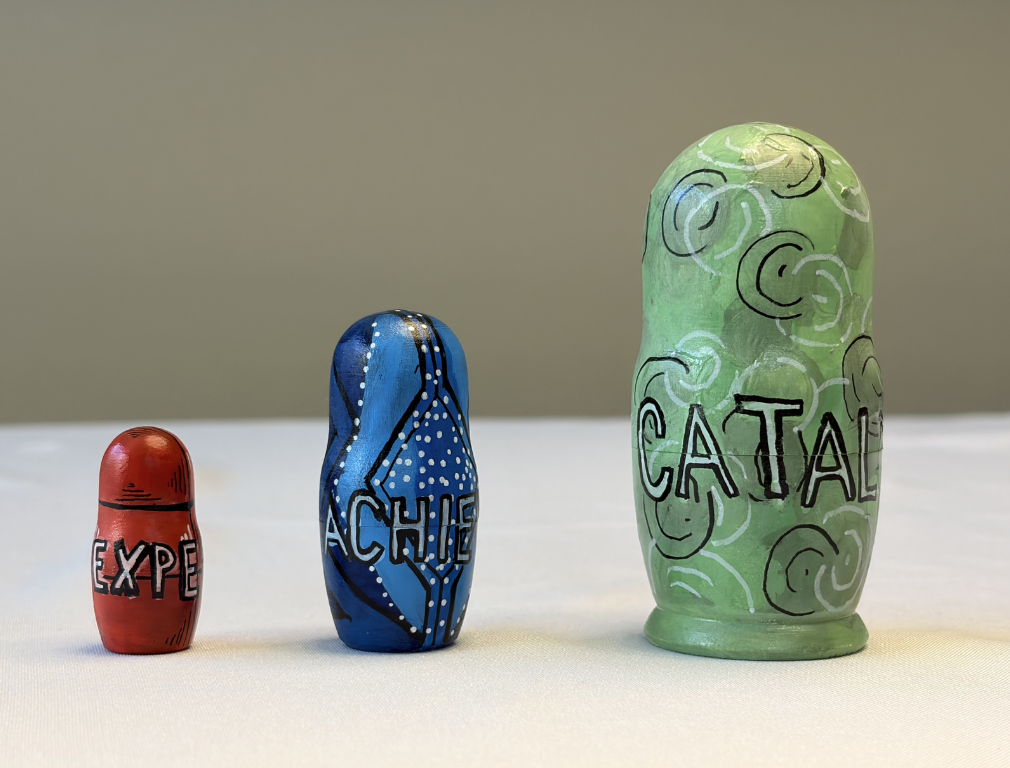
With special thanks to Christina Carlson for the hand-painted expert, achiever, and catalyst wooden nesting dolls she made for Pete Behrens for illustrative use in his workshops.