63: Changing Culture From Within: A Schneider Electric Change Agent on What It Actually Takes
EPISODE 63
About This Episode
Schneider Electric is one of Agile Leadership Journey's clients — a global industrial technology company with more than 160,000 people and one of the most complex supply chains in the world. In this episode, Pete Behrens sits down with Paul Stonehouse, who works inside that organization not as an outside consultant, but as an internal change agent trained and licensed through Agile Leadership Journey and embedded in the culture he's working to shift. Paul's candor about the tension and complexity of real transformation — and his gift for making the invisible visible through vivid metaphor — make this one of the most honest conversations of the season about what culture change actually takes.

About Your Host
Pete Behrens
Founder & CEO, Agile Leadership Journey
Pete Behrens is the host of the Relearning Leadership podcast, author of Into the Fog: Leadership Stories from the Edge of Uncertainty, a sought-after keynote speaker, and Founder/CEO of Agile Leadership Journey. With over three decades of guiding leaders through uncertainty, he has worked with Fortune 500 companies, including Salesforce, GE Healthcare, Google, and the Federal Reserve Bank of New York, impacting 15,000+ leaders worldwide.
Pete's journey from engineer to CEO to coach revealed a fundamental truth: the most complex challenges aren't technical—they're human. This insight shaped both his personal approach and the foundation of Agile Leadership Journey, which transforms organizations by developing leaders equipped to navigate complexity and change.
ABOUT OUR GUEST
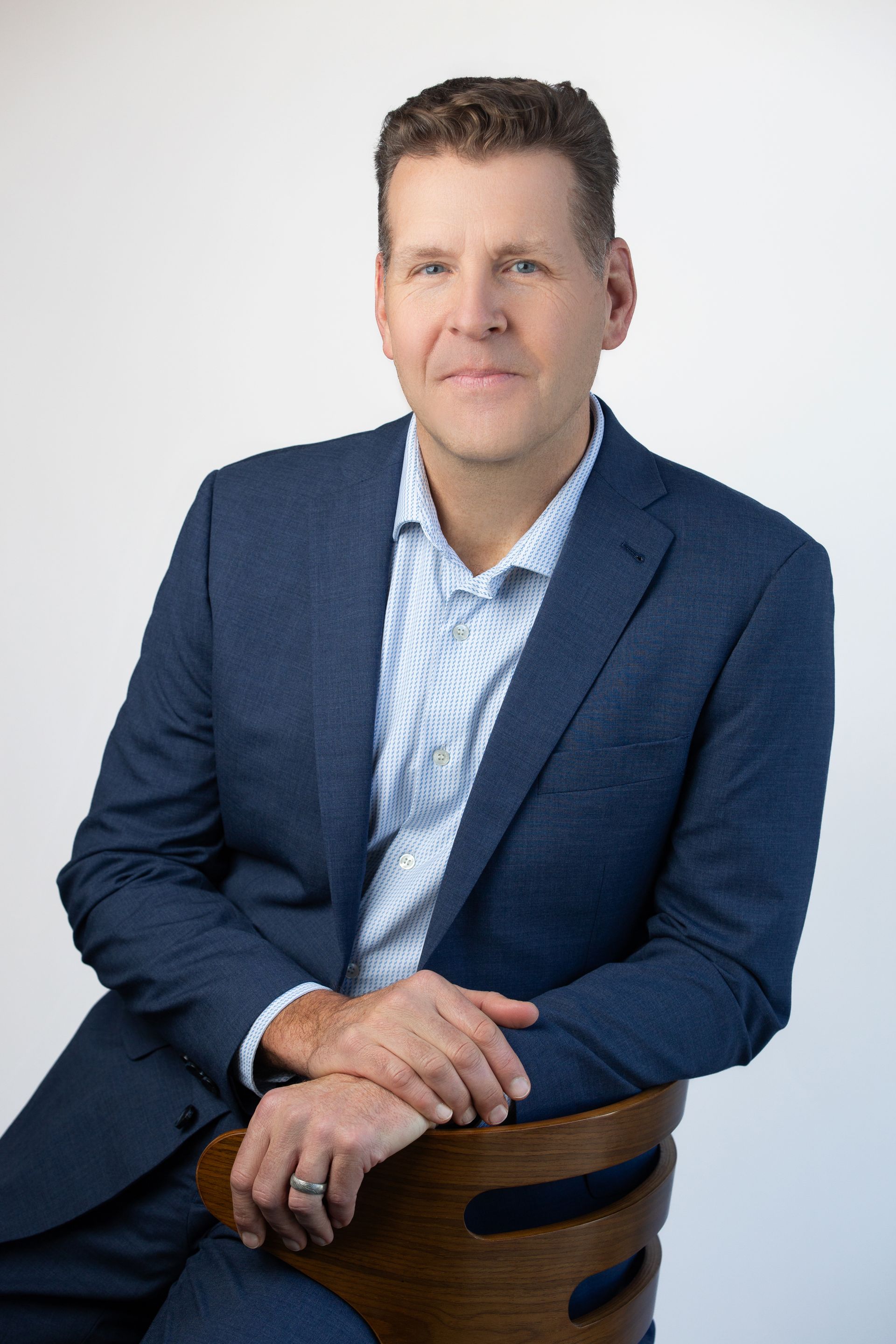
Paul Stonehouse
ALJ Internal Guide & Lean-Agile Transformation Coaching & Development Lead, Schneider Electric
Paul Stonehouse works at the intersection of leadership development and organizational transformation inside one of the world's most complex supply chain operations. Based in Grenoble, France, Paul serves as Schneider Electric's GSC Transformation Coaching & Development Lead — a role he has held since 2021 — and is a trained and licensed Guide through Agile Leadership Journey.
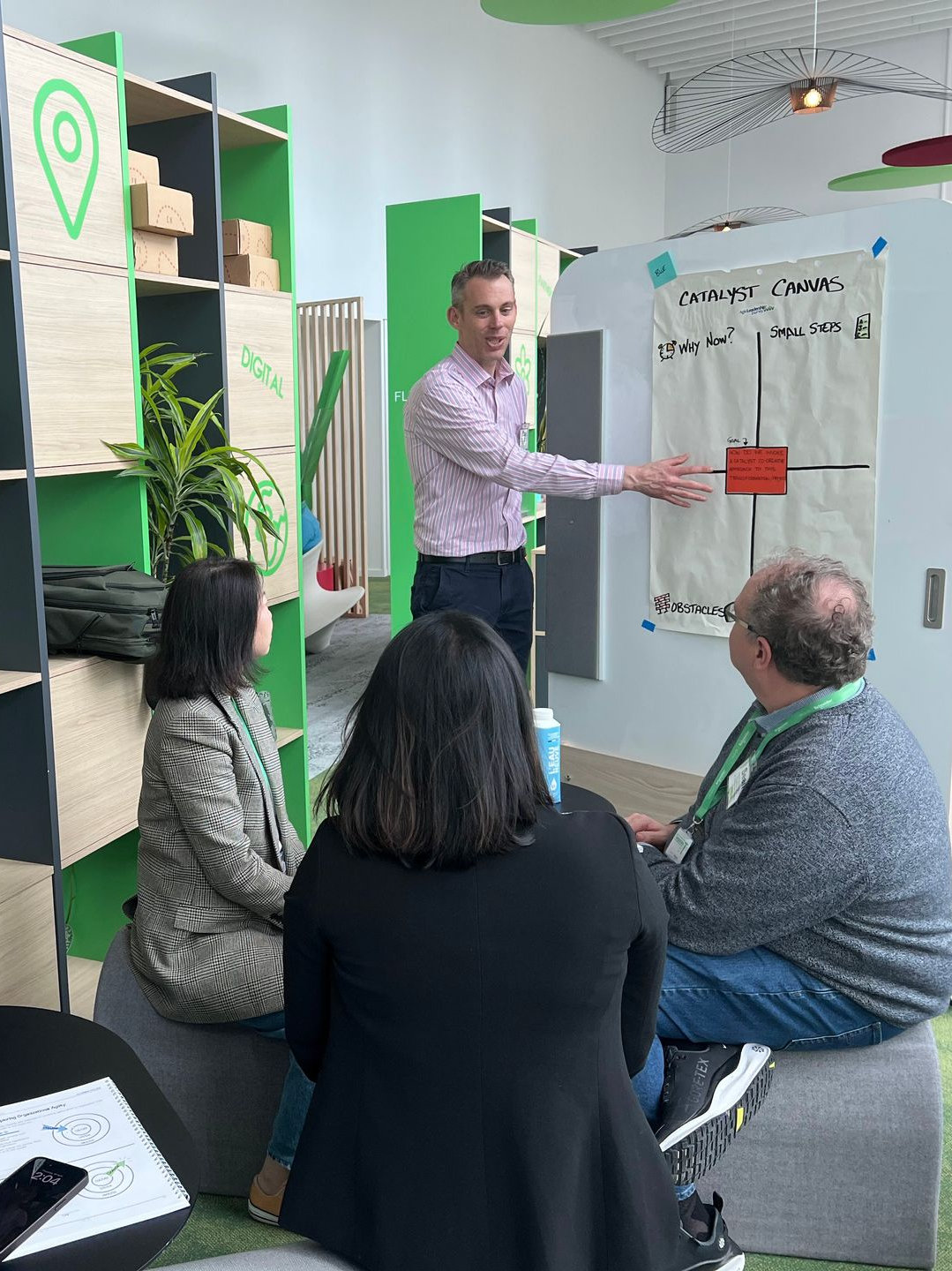
Paul's work spans coaching, facilitation, community building, and large-scale transformation across Europe, India, China, North America, and Southeast Asia. He has trained more than 7,000 professionals in lean-agile mindsets, Catalyst Leadership, design thinking, systems thinking, and coaching and facilitation skills. His core focus is helping leaders and teams find more effective, human, and sustainable ways of working — adapting his approach to the cultural and organizational context of each environment.
Paul's driving ambition: empowering people to find meaning and pleasure in their work by modeling and enabling better collaboration and problem-solving.
Relearning from This Episode
Culture Is the Water You're Swimming In
Most people inside an organization don't notice the culture they're in — they're living it every day. Making it visible, naming it, and creating a shared language around it is often the most powerful first move. Once you shine a light on a problem, you can't stop looking at it — and that shared awareness becomes the foundation for change.
Empowerment Without Clarity Is Just a Blindfold
Telling people they're empowered means little if the structural, metric, and policy boundaries around them remain invisible. People will keep running into fences they can't see — and eventually, the safest strategy becomes simply to stop moving. Real empowerment starts with making the boundaries visible.
You Can't Cut a Flower Off Someone Else's Plant and Expect It to Grow
Scaling culture change by importing solutions from the outside — or copying what worked elsewhere — rarely produces lasting results. Real transformation has to be cultivated from within, rooted in the local culture and context, and tended over time. Shortcuts produce compliance, not change.
Fewer Targets, Better Decisions
One of the most meaningful shifts inside Schneider Electric has been reducing the number of KPI targets — distinguishing between what needs to be driven and what simply needs to be monitored. When everything is a target, siloed behavior follows. When leaders focus on fewer, better measures, teams are freed to think and work horizontally.
Explore Recent Episodes
Episode Transcript
Pete Behrens:
Welcome to Relearning Leadership, I’m your host Pete Behrens.
In our
last episode, we talked about disruption. The forces reshaping global supply chains.
Geopolitical risk, decarbonization, the pace of AI.
And the argument I made is that these forces aren't fixed through better planning.
They're demanding a different kind of leadership. Catalyst Leadership.
Which leads back to a common question.
What does that actually look like?
Inside a real company.
With real pressure.
Real politics.
Real quarterly targets.
That's where this episode comes in.
I sat down with Paul Stonehouse.
Paul works inside Schneider Electric — about 160,000 people globally, one of the biggest players in electrical distribution and energy management.
And Paul isn't someone who was brought in to run a transformation program.
He's one of their employees, working to shift the culture from the inside.
What I didn't expect was how vivid Paul is.
Paul thinks in pictures.
He describes culture as a reef — as if you're a fish swimming through it every day, and you don't even notice the water until someone asks you how it is.
He talks about empowerment as being blindfolded in a field surrounded by an electric fence. Where you get zapped by the system if you make a wrong move. So after awhile, the smartest strategy is just to stop moving.
And then there's this image of a flower, which I’ll tease up for you to listen for.
So, without further ado, here’s my conversation with Paul Stonehouse.
I’m Pete Behrens, thank you for listening or watching.
Interview
Pete Behrens:
Thanks for joining me today. this is a really interesting point to maybe reflect and plan. Maybe just give us a picture of who Schneider Electric is and this global supply chain group that you work with.
Paul Stonehouse:
Okay. So Schneider Electric, one of the global leaders in electrical distribution from everything from a very small breaker or light switch all the way up to applications on the cloud and control systems. I think it's around 150, 160,000 people globally. Global supply chain is around 50, 60% of that.
One of the big things that we have now for Schneider Electric is that with the, the decarbonization efforts and the increase in electrical usage, this is a big growth factor for us. One of the other things that we have now is just the complexity and interdependence of a lot of our supply chain.
You have local regulations, you have government and geopolitical risks. As we're speaking right now, there's wars going on and there's war starting, which is creating supply chain risks.
So we've built a lot of capabilities that allow us to deal with these changes. We have an end-to-end control tower, which helps visualize this. But what we're noticing as well is that as you go into these problems with decarbonization, as you go into electrification, in addition with the augmentation on demand and data centers and AI, all of these things are meaning that there's a huge amount of interdependence and flows, which means that we need to be more resilient.
And resiliency means that we need to have people who understand better, who are able to sense the problems and detect them quicker. This combined finally with the speed of change and the rate of change in the markets means that our ability to be resilient and respond to change more effectively is the the driving factors right now for Schneider Electric.
Pete Behrens:
So big company. Big problems. One of the things that you described there is disruption. And I think if there's a common trend of why agility is necessary globally today, it feels like disruptions are increasing globally. Whether that's climate, geopolitical, social, technology.
When we first came into Schneider, I think it was a couple years ago now we took a snapshot of your culture. And we brought it to some of your senior leaders and it provided an interesting view and I'm wondering if you'd describe that in your terms, what resonated with the senior leaders?
Paul Stonehouse:
I think one of the things that we see is that as a culture is a macro, mega thing that's you encounter day to day. Like one of the visualizations I always think of as like a small fish and a reef. You're going in and out every day and you're living on the reef and you don't realize until someone asks, how's the water that you've been swimming the whole time.
And so what this did is this asked everyone to stop and say, how's the water? Is the water toxic? How's the visibility? And I think the cultural values framework was the first time when everyone knew what it was, but it helped create that discussion point to say this is where we are, this is where people want to be.
And more importantly, there's a collectiveness to it, it's that idea of shining a light on a problem. Once you shine the light on it, you can't stop looking at it. We now know that we need to clean up the reef together and it's visible.
Pete Behrens:
Interesting. I always love your stories of metaphors and pictures, imagery of description. One of the things you're describing is a shared language, which we find to be incredibly valuable for leadership alignment.
The other thing is focus, we often call this a north star. It doesn't tell you what to do. It just points in a direction of where we can get better. And one of the things I heard from your senior leadership team is your cultural map indicated a very driven culture. What problems were you seeing in that over-reliance on a control compete culture?
Paul Stonehouse:
One of the things we talk a lot about is, how do we start to break the silos? Or I try to say, before we break them, let's try to bridge them first. 'Because silos are important because they bring efficiency, but bridging them allows us to go horizontally to deliver value.
And I think one of the things that's really important is that it allows us to still manage this top down culture, because we still need to have hierarchy in such a large company. But at the same time, how do we have this sort of dual operating model where we can see things horizontally and top down?
So it's more about shifting and adapting rather than doing a cultural transformation.
Pete Behrens:
Interesting. We call this tweak the system versus open heart surgery. And that leads us to our next stage. So as we work with leadership teams through the change process, we work in two dimensions. There's one dimension, which is mindset. Which is working with leaders on a new way of thinking and new way of behaving. We call that the micro culture journey. We get hundreds of leaders, thousands of leaders, starting to change, it changes culture.
Today in this session, we're gonna focus a little bit more on the macro journey. The macro culture, the macro levers. Let's talk a little bit about these levers and what are you seeing?
Paul Stonehouse:
The really nice thing about this bottom half of the compass and focusing on the culture is it aligns with what you said. It's about getting business results. And at the end of the day, we need to get those results. Now, it's how do you shift the experience internally to start to shift these things?
I was working with one leader and during a workshop they were mentioning that this is the first time in their career in Schneider, and that they're senior leaders, so they've been here quite a long time, it's the first time in their career that they actually have fewer KPIs to deliver.
And we're trying to delineate between targets and indicators. And making sure that indicators, we still need them because they maintain the health of the system and in the event something goes wrong, they help us roll that back. But the idea of trying to reduce the number of targets and moving that to an indicator, because we want to know the health, we don't necessarily need to drive siloed behavior.
Going back to my topic of silos is sometimes these KPIs that become targets, they create that siloed behavior. And that's part of the interesting thing is that as we talk about growth mindset, as a culture, how can I make sure that my planning departments, that’s talking to my logistics department, that's talking to my supply chain department, that's talking to procurement. How do we start to create this horizontal view?
Pete Behrens:
I think you're bringing up a really interesting point. We often talk about policies and metrics. And the difference we talk about is metrics are really just data points. Policies are governance around some of those. And what you're indicating here is a tendency is to take anything we measure and it becomes a KPI or a target as you say, which in a sense is adding governance to it. It's putting pressure on that, on the indicator.
What you're talking about here is a really interesting one, which is what are the ones we really wanna focus on that are gonna be driving certain behaviors? And when we pick too many, that becomes a problem itself. I just wanted to pause on that one and have you reflect on it.
Paul Stonehouse:
Yeah. Like just another visualization is, I've got the silly watch. I used to get stressed out about my sleep score so I wouldn't get a good night's sleep. So, so it, it is exactly that, but I have another KPI for my health, but it's actually causing a detriment in your health.
In France, we have this word called infobesity, this idea that we're just overwhelmed with information. And we have too much of it so we're obese with the amount of information we have. And I stole this idea from Russell Ackoff, he had this idea that there's data, information, knowledge, understanding, and wisdom. The value chain.
The data and the information has become very commoditized. The information age and digitization has made this easier and easier to come to. So that's why we have so much information is it's easy to produce.
Now we go up to the next level of understanding, AI is making this a commodity. It's very quickly going to commoditize all the knowledge work that we have. So now we're going to focus on understanding and wisdom. And I think understanding and wisdom requires a lot more involvement of people understanding people, making sure they understand system thinking and network effects.
And I think that's where the agile leadership journey and understanding where our culture is, that allows you to focus less on getting more data points, less on getting more information and going more towards wisdom. And I think that's the global aspiration for the company is that we're gonna move more towards wisdom and having people being more effective rather than focusing on the commoditization that AI and the information you just brought us.
Pete Behrens:
Awesome.
Paul Stonehouse:
I had three leaders and they followed the idea of the three amigos. One was focused on more delivering projects, one was focused more on the IT, and one was focused more on the data and the data governance side. And what these three leaders did is they formed their own squad or league or team. And they started to work together and they asked, whenever the project team has problems, rather than you coming to us one by one, you're gonna come to us together as a collective.
And what they reported was not necessarily that the work sped up a lot, but actually they had to make fewer small decisions. And fewer low value decisions about escalations. The escalations were reduced because now the people know that the managers are aligned.
If we're going to bring them a problem, we have to be aligned before we bring it to them. And this small micro structure change has created a big impact for the team. When I talk to them on a day-to-day basis, they're happier because they know their boundary.
Pete Behrens:
I love that construct. And it reminds me of, it was a similar organization in healthcare, where we were doing this and they developed that leadership council to make decisions at speed. And that is a key thing to be able to get access to all the key decision makers at the same time, to bring the problem and discuss versus the back and forth that often happens with all these individuals. That's an awesome example.
So, as we're thinking about change through this system, Schneider's huge, pervasive across different regions, product sets, technology areas. What are some of the biggest challenges you're running into as you're starting to propagate change or try to scale?
Paul Stonehouse:
If I go back to my first example of us being the fish on the reef it's very easy to try to outsource the problem, for example, big consultancy. And basically they're a shark on the reef and you're gonna outsource it, then they're gonna eat some of your problem. Right? But if you keep outsourcing that for sure, they're gonna take care of part of your problem, but it's not a systemic change. They're just scaring everybody else into compliance.
It's one of those things where to change at scale, you need lots of small changes. You need all the fish to get together rather than just trying to outsource it and make a transformation program.
Pete Behrens:
What I'm taking from this and bring it back into business. We could come in with change. But we don't, because we know that change often isn't native. It's not natural. It doesn't always stick. It can be quick, but not always effective. One of our approaches is to guide leaders to drive change themselves. Get the organization itself, the education it needs to drive and manage this change process.
So, what I'm hearing number one is that's a challenge, but also you're seeing that people taking ownership and starting to be empowered. Are you seeing any of that? Are you seeing any positive response in terms of leaders taking that?
Paul Stonehouse:
There's a lot of change in the language and there's a lot of change in the way that we're talking about the change. Mm-hmm. Sometimes that leads to that hypocrisy of people saying stuff, but not to necessarily doing stuff. So if you want, I can share one more, but my empowerment story.
Pete Behrens:
Yeah.
Paul Stonehouse:
So I have the story about empowerment is this idea of empowerment is a bit like telling someone that they're empowered by it, by giving them a blindfold and putting them out in a field. So, where I live in France, we have, we have lots of fields out here where the cows roam. And so you can imagine that you have this electric wire around the field and you're walking around, but you're blindfolded and you've been told you're empowered and you need to achieve your goals.
So, of course you walk and the, because it's a cow, it's a big beast. These, these electric wires, they're very powerful and they give you a good zap. Once they give you the good zap, of course you stop and you try to go another way and after a while your best strategy is just to stop moving.
And so your empowerment has led to you going up against the structural electric fence. It's led you going against the metric electric fence. It's led you to go against the policy electric fence, because you keep getting slapped for all the things that you've been touching that you didn't know. And I think this idea of empowerment is how do we make sure that things are visible? How do we know where we are so we can start removing the blindfold to know where we can change and where we can't? So, I think this is one of those ideas.
The same with collaboration. One of the things that we've seen from collaboration is when you look at it through the different mindsets of expert achiever and catalyst, the idea of collaboration is very different than expert leader when they see collaboration, bcause they're very good at one-on-one. They're going to say, “I'm collaborating,” because Pete and I are talking. The achiever leader's gonna say, well, I'm collaborating 'cause I've told them all to get on the bus and we're all going somewhere. So we're collaborating. And the catalyst leader realizes that they have to release the chains and release the reins and release control.
And that feels very uncomfortable to go from that achiever to catalyst. It's a big jump. So I think the language is changing, but it's going back to the idea about how do we know that hypocrisy, that's part of our natural phases of changing the language. But follow that with the behavior change as well.
Pete Behrens:
What you're indicating is all of the interconnections between the leadership mindset and the structure and policies and metrics. And most of these structures, policies, metrics, have been built with a mindset in mind. And to try to pull them apart is impossible.
This is why we have both sides of our compass, we talk about the mindset and if we can't change the mindset. We're not going to be able to change the policies because the policies are a reflection of it. And I think what you're reminding me and reminding why we do what we do is to recognize that in order to get access to these new levers, we've got to start changing the way people are thinking and, and believing and behaving.
Paul Stonehouse:
Yeah. And to change at scale it's that idea of how do we emerge the change. So, I don't know if we have time, but I can finish with my final, final mental model. But if you can imagine for the people they're listening, it's, it's this idea that, you know, I'm trying to plant a flower and I have this beautiful pot with all the, the soil inside. I plant my seed. And the idea is that if you water it and take care of it, of course it's gonna start to grow leaves. It's gonna start to grow a plant. If I continue to take care of it, it's gonna grow this beautiful flower. When you try to do things at scale, and when you try to go things very fast, you just see the flower and you try to cut off the flower and put it on your plant, and of course it dies, right?
So the idea is how do I start with leadership and cultivate the plant towards what I want it to be? Rather than just trying to do the open heart surgery where I cut off the flower and put it on my own plant.
Pete Behrens:
We want the end result without the work it takes to get that end result, which is a patience problem. And I think one of the challenges we have with many organizations, and you even talked about it earlier, do we have time to do this kind of change. There's so much disruption going on, so much change happening so quickly. We've gotta respond to the market.
Do we have time? Isn't it quicker just to, you know, have somebody else cultivate the flower, we'll cut it off, we'll put it over here and just use it for a while. It's interesting because I think this journey, this agile leadership journey, is one that does take time.
Do we have time? Does Schneider have time? I'm putting you on the spot here.
Paul Stonehouse:
I'll go back to Deming. I think Deming said adaptation isn't mandatory, but neither is survival. It's this idea that if you don't make the time now, maybe you won't have the time later either, because you just won't be around.
So, for me being adaptable, hitting our goals, especially as we have huge amounts of growth. Resiliency requires a growth mindset, because if you're resilient with a fixed mindset, you're just going to try to do the same old tricks. Resiliency and using a anti-fragile patterns means you're gonna grow the organization, you're gonna grow capability.
And with the advent of AI and the commoditization of knowledge work, we have to change. So I think it's a survival instinct. And I think my company, I'm in the fortunate position where our back isn't against the wall yet. We're not facing a crisis. Our leaders are very forward looking and so I have a lot of energy and optimism for the future.
Pete Behrens:
It's a great message. For those companies that only do to this change because their backs are against the wall, it's often fraud. That it's when you can start to do this ahead of that curve, I think that's really critical.
The other thing you mentioned, which I think I just wanna highlight here is, you're talking about all these little micro results, These little bits of where this project, this leadership team, this group, these silo bridging, these are all micro things. I call this marginal gains. We don't transform overnight. We don't transform in a year or three years. We transform because we do a dozen, two dozen, 10 dozen micro transformations. And then all of a sudden it looks like this brand new plant. And I think what you're describing is exactly that. All these small little things that are happening that are changing.
Paul Stonehouse:
Yeah. It's the idea of emergence, things are emerging. You try to make things more fractal and you look at things more as, um, a system rather than a bunch of independent initiatives.
Pete Behrens:
Awesome. Well, I want to say thank you for allowing us to share your story.
Anything else you want to add in closing?
Paul Stonehouse:
Enjoy the journey. One of the quotes I had was, yesterday I was smart, so I tried to change the world today and wise so I changed myself. I probably got the quote wrong, but of that nature. It is that idea of, start with yourself, start internally. And then try to bring people along for the journey because doing a journey together is a lot more enjoyable than being alone.
Pete Behrens:
Yeah. And it's not easy. Thank you, Paul.
Paul Stonehouse:
Thank you.
Pete Behrens:
I’m Pete Behrens, thank you for listening or watching.
Relearning Leadership is the official podcast of the Agile Leadership Journey. To learn more, visit relearningleadership.show.
Narrator:
If you enjoyed this episode, it's drawing from one of the dozens of stories in Pete's debut book, Into the Fog: Leadership Stories from the Edge of Uncertainty. Available in hardcover, paperback, ebook, and soon to be released audio. Get your copy today from Amazon.